Alcotec 8359 | Alcotec 23% Turbo Yeast | | The new alcotec 23% turbo yeast will produce 23% alcohol, using 10.5kg of brewing sugar. (Dextrose Monohydrate) You can NOT use normal sugar! New type of recipe with added carbon and minerals. Use together with Alcotec TurboKlar. | | |
| |
5800 | Alcotec 24 hour Turbo Yeast | | Alcotec 24 is the most extreame yeast you have ever seen. It will ferment 6kg of surgar in 25 litres of water, up tp 14% in 24 hours. This is not a fermentation, its an explosion! | | |
| |
9674 | Alcotec VodkaStar | | The Vodka star is extremely temperature tolerant. This is the yeast to use for the realy high temperatures. With its pure fermentation, it is also perfect to use in combonation with simeple pot stills. | | |
| |
Brewmaker 7568 | Brewmaker General Purpose Wine Yeast (tub) | Range currently unavailable, try Youngs General Purpose Wine Yeast for a similar result.
This is a general purpose yeast compound that is suitable for most wines without being specific in its application. | | Net Weight: 55 g | |
| Product Currently Unavailable |
BrupaksRead more about Brupaks 5500 | Brupaks Ale Yeast | | Genuine Top Fermenting yeast. Ferments well at low temperatures (down to 12ºC) and has a high alcohol tolerance (up to 12% abv). | | Net Weight: 6 g | |
| |
Danstar 3702
Information | Danstar Beer Yeast, Nottingham | | The Nottingham strain was selected for its highly flocculant (precipitating) and relatively full attenuation (transforming sugar into alcohol) properties. It produces low concentrations of fruity and estery aromas and has been described as neutral for an ale yeast, allowing the full natural flavour of malt to develop. Good tolerance to low fermentation temperatures, 14°C (57°F), allow this strain to brew lager-style beer. Recommended 14° to 21°C (57° to 70°F) fermentation temperature range. | | |
| |
 5631
Information | Danstar Beer Yeast, Windsor | | Danstar Windsor ale yeast originates in England. This yeast produces a beer which is estery to both palate and nose with a slight fresh yeasty flavour. These are usually described as full-bodied, fruity English ales. Depending on the substrate, the Windsor demonstrates moderate attenuation which will leave a relatively high gravity (density). Recommended 17° to 21°C (64° to 70°F) fermentation temperature range. | | |
| |
Favourite 4126 | Favourite High Active / Restart Yeast | | up to 5 gal | | |
| |
Fermentis 5087
Information | Fermentis Ale Yeast, Safale S-04 | English ale yeast for the production of a large range of ales. Fast firmentation.
- Sedimentation: High
- Final Gravity: Medium
- Temperature Range: 15-24°C
| | Net Weight: 11 g | |
| |
 1428
Information | Fermentis Ale Yeast, Safale US-05 | An American ale yeast producing well balanced beers with a very clear crisp end palet.
- Sedimentation: Medium
- Final Gravity: Low to Medium
- Temperature Range: 15-24°C
| | Net Weight: 11 g | |
| |
 2940
Information | Fermentis Ale Yeast, Safbrew T-58 | A speciality yeast selected for its estery somewhat peppery and spicy flavour development.
- Sedimentation: medium
- Final gravity: high
- Temperature Range: 15-24°C
Also recommended for bottle-conditioning of beers. Excellent performance in beers with alcohol contents of up to 8.5% v/v but can ferment up to 11.5% v/v. | | Net Weight: 10 g | |
| |
 5263
Information | Fermentis Lager Yeast, Saflager S-23 | Genuine bottom fermenting commercial yeast for lager and pilsner beer production.
- Sedimentation: High
- Final Gravity: Medium
- Temperature Range: 11-24°C
(ideally 11-15°C)
| | Net Weight: 11 g | |
| |
 4752
Information | Fermentis Wheat Beer Yeast, Safbrew WB-06 | A speciality yeast selected for wheat beer fermentation. The yeast produces subtle esters and phenol flavour notes typical of wheat beers.
- Sedimentation: low
- Final Gravity: High
- Temperature Range: 11-24°C
| | Net Weight: 11 g | |
| |
 1449
Information | Fermentis Wheat Beer Yeast, Safbrew S-33 | A very popular general purpose yeast, displaying both very robust conservation properties and consistent performance. This yeast produces superb flavour profiles and is used for the production of a varied range of top fermented special beers (Belgian type wheat beers, Trappist, etc.).
- Sedimentation: medium
- Final gravity: high
- Temperature Range: 15-24°C
Also recommended for bottle-conditioning of beers. Excellent performance in beers with alcohol contents of up to 7.5% v/v but can ferment up to 11.5% v/v. | | Net Weight: 10 g | |
| |
Gervin 7271 | Gervin No 1 Yeast (GV1) | Green label S.cerevisia Bordeaux strain 7013
This yeast, known in the trade as Fermivin, is from the Bordeaux region, and has been widely used in France and elsewhere for the production of both red and white wines. It starts readily, ferments at temperatures down to 15°C, and clears without difficulty. It is rather less sensitive to sulphur dioxide than most wine yeasts and can tolerate up to 100 ppm (total). It has been found to be suitable for the production of wines made from the majority of ingredients favoured by amateurs, and is ideal as a general purpose yeast for producing wines of up to 18% alcohol strength. | | |
| |
 9624 | Gervin No 2 Yeast (GV2) | Red label. S.cerevisia Montrachet Burgundy Strain, Davis 522
This is a very vigorous yeast that gets away fast, thus ensuring a minimum risk of bacterial spoilage. It can be used for either red or white wines, but it is especially suitable for red wines based on autumn fruits such as blackberries, elderberries and sloes. Like No. 1 yeast it will ferment down to 15°C. Do not use this yeast if the must has been too heavily sulphited, since it may then form some hydrogen sulphide, especially if the must is low in nutrients. | | |
| |
 6462 | Gervin No 3 Yeast (GV3) | Yellow label. S.cerevisiae (bayanus). Pasteur Institute strain
This is another well established yeast that has proved to be very popular with amateur winemakers. It is a yeast intended for the production of sparkling wines, but it has a much wider application than this. Thus it will produce wines with an alcohol level of between 15 and 19% from a must with adequate levels of sugar and nutrients. Since this yeast continues to ferment sugar long after most yeasts have given up, it is not the best yeast to use for making sweet table wines with lowish levels of alcohol. Keep it for sparkling wines, dessert wines and wines that have 'stuck' because too much sugar was used in making up the must. Fermentation starts a little more slowly with this yeast than with Nos. 1 and 2. The best temperature range for the yeast is 12-30°C. Keep the sulphur dioxide level below 25ppm. | | |
| |
 8802 | Gervin High Alcohol Yeast French Strain (GV4) (GV26) | | Particularly suitable for making high alcohol beverages (±21% if adequate nutrient present) | | |
| |
 1070 | Gervin No 5 Yeast (GV5) | White label. S.cerevisiae, Strain GVN
This French yeast is especially recommended for the production of quality white table wines from grapes and other fruits, It forms little foam and ferments well at low temperatures (down to 7°C) thus ensuring the development the esters that provide fruity and floral character. This yeast is used commercially for the production of English table wines. | | |
| |
 8766 | Gervin Sauternes Yeast R2 (GV6) | | For producing quality white wines. Ferments down to 5°C | | |
| |
 5306 | Gervin Varietal A Yeast (GV8) | Red/White label. S.cerevisiae. Strain SF (7303),
This French yeast was selected by INRA at Narbonne to complement the characteristics of the grapes. It is used for the production of red Bordeaux (Claret) wines. It is described as an 'aromatic' yeast which develops a pleasant and lasting aroma. It gives minimum frothing and volatile acidity, has a short lag phase, and will tolerate alcohol levels of up to 16%. It ferments well over the temperature range 15-35°C, with a good yield of glycerol. It will tolerate free sulphur dioxide up to a level of 50 ppm. | | Capacity: to 5 gal |
| |
 2932 | Gervin Varietal B Yeast (GV9) | Black/White label, S.cerevisiae. Narbonne selection. Strain CC.
This French yeast is another INRA (Narbonne) selection made to ensure the production of wines with excellent aroma characteristics. The manufacturers refer to the yeast as cryophilic, since it will ferment satisfactorily at temperatures down to 10°C. This low temperature fermentation yields wines with a young fruity bouquet, and is recommended for the production of wines with the fruity ester characteristics of those from the Rhine and Moselle. It will also ferment well at temperatures up to 35°C. This yeast gives good alcohol yields - 1% v/v for every 16g/litre of sugar - and is low foaming and produces very little volatile acidity. It will tolerate up to 50 ppm of free sulphur dioxide. It has the useful characteristic of being able to metabolise (use up) 20% or more of any malic acid in the must (converting it to ethyl alcohol), and is hence useful for dealing with musts based on high acid fruits such as gooseberries and grapes from cool climates such as England. | | Capacity: to 5 gal |
| |
 1384 | Gervin Varietal C Yeast (GV10) | | For sparkling wines and high alcohol wines.
Can be used for; sweet white, dessert, aperitif, champagne, mead, apple, sparkling and stuck fermentions. | | Capacity: to 5 gal |
| |
 2434 | Gervin Varietal D Yeast (GV11) | Red-on-white label. S.cerevisiae. Strain 71B.
This yeast has two special characteristics. Firstly it produces rounder, smoother wines with outstandingly good bouquets, which tend to mature quite quickly. It is said to be good for producing young fruity red wines. Experiments with some 10 leading brands of grapebased kits, showed that this yeast gave better results than the yeasts provided in the kits or two other selected wine yeasts. The second characteristic is its ability to metabolise up to 30% of any malic acid present in the must, again producing ethyl alcohol. Accordingly the yeast is good when country wines are being made from high malic acid ingredients such as apples, gooseberries and rhubarb. Up to 14% of alcohol can be tolerated by this yeast. It should be noted that the yeast has a rather longer lag phase than most, such that fermentation may not start fully for up to 24 hours. | | Capacity: to 5 gal |
| |
 9224 | Gervin English Ale Yeast [top] (GV12) | | Net Weight: 11 g | |
| |
Lalvin 6627
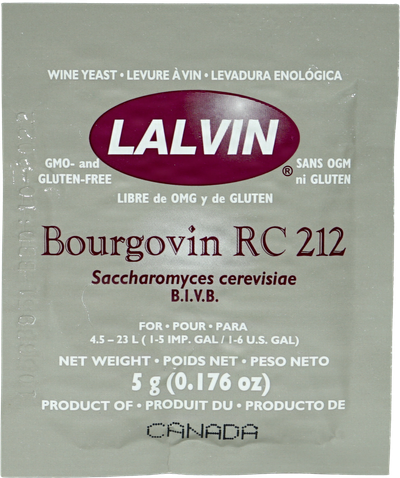
Information | Lalvin Wine Yeast, RC212 | | Use for producing red wines of smooth character and balanced structure. (Burgundy) | | Net Weight: 5 g | |
| |
 3892
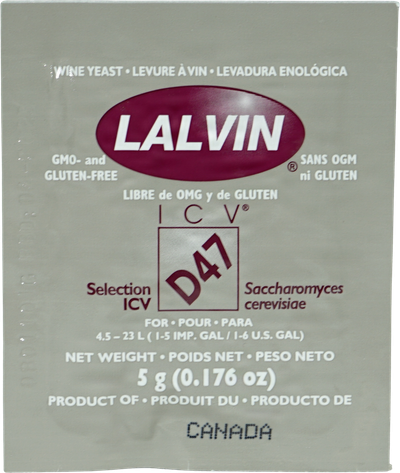
Information | Lalvin Wine Yeast, ICV-D47 | | Use for producing superior quality white wine. (White Wine) | | Net Weight: 5 g | |
| |
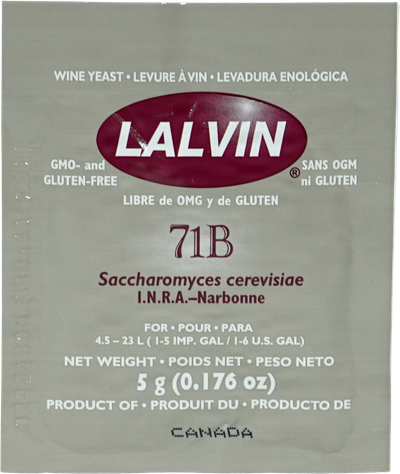
 6753
Information | Lalvin Wine Yeast, 71B | | Use for producing wines with a fruity aroma. (Nouveau) | | Net Weight: 5 g | |
| |
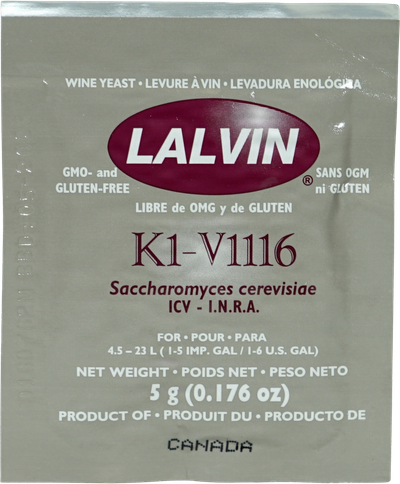
 8932
Information | Lalvin Wine Yeast, ICV-K1 (V1116) | | Use for producing wines from grapes and fresh fruit. (All Purpose and stuck fermentation) | | Net Weight: 5 g | |
| |
 6827
Information | Lalvin Wine Yeast, EC-1118 | | Use to produce sparkling wine and cider.(Champange) | | Net Weight: 5 g | |
| |
MuntonsRead more about Muntons 4816 | Muntons Premium Gold Genuine Ale Yeast | The yeast rehydrates at 20°C and therefore simply requires sprinkling onto the surface of your wort - no need to stir - and the yeast will rehydrate and activate within just a few hours. The yeast has excellent crusting characteristics forming a firm 'jelly like' deposit at the bottom of the fermenter and bottle or barrel. Flavour profile is excellent and the yeast has the ability to drop out of suspension very rapidly. There is a major benefit if you are bottling your beer. When pouring your beer you will not disturb the firm yeast sediment and therefore can fill your glass safe in the knowledge that it will be a clear bright pint. This benefit also applies when you are siphoning your beer from the fermenter into your bottles or barrel. Once again the firm crusting characteristics will ensure that you transfer all of your beer to your bottles or barrel and therefore will not waste any. | | Net Weight: 6 g | |
| |
Youngs 6515 | Youngs General Purpose Wine Yeast (tub) | | This is a general purpose yeast compound that is suitable for most wines without being specific in its application. | | Net Weight: 60 g | |
| |
Back to TopWWW.STONEHELM.CO.UK ------------------------------------------------------------------------- © 2004,2005,2006,2007 Stonehelm. All rights reserved |